Customer retention is the ability to keep existing customers coming back to your business over time. For small businesses, it is one of the most powerful levers for sustainable growth, yet many owners pour the majority of their budget into acquiring new customers while neglecting the ones they already have.
The numbers tell a compelling story. Research from Bain & Company shows that increasing customer retention rates by just 5% can boost profits by 25% to 95%. Meanwhile, acquiring a new customer costs five to seven times more than retaining an existing one. Despite these economics, many small businesses operate without a deliberate retention strategy.
This guide covers practical, proven customer retention strategies that small businesses can implement without a massive budget or dedicated marketing team. Whether you run a home service company, a local retail shop, or a professional services firm, these approaches will help you build lasting customer relationships that drive repeat revenue.
Why Customer Retention Matters More Than Acquisition
Before diving into specific strategies, it helps to understand why retention deserves at least as much attention as acquisition.
Existing customers spend more. Repeat customers spend on average 67% more than first-time buyers, according to BIA/Kelsey research. They already trust your business, understand your offerings, and require less convincing to make a purchase.
Retention drives referrals. Loyal customers become advocates. They leave positive reviews, recommend your business to friends and colleagues, and amplify your marketing efforts at no additional cost.
Predictable revenue stabilizes your business. A base of returning customers provides consistent monthly revenue that makes it easier to plan, hire, and invest. Relying solely on new customer acquisition creates a feast-or-famine cycle that is difficult to sustain.
The Cost of Losing Customers
Customer churn --- the rate at which customers stop doing business with you --- compounds quickly. If you lose 10% of your customers each month, you need to replace all of them within a year just to stay flat. For a small business without deep pockets, that treadmill is exhausting and expensive.
Understanding where customers drop off is the first step. A CRM system helps you track every interaction, identify at-risk customers, and intervene before they leave.
7 Customer Retention Strategies for Small Businesses
1. Personalize Your Follow-Up Communications
Generic “thank you for your purchase” emails do not build loyalty. Customers expect communications that reflect their history with your business, their preferences, and their specific needs.
Effective personalization includes:
- Using the customer’s name in subject lines and greetings
- Referencing their purchase history when making recommendations
- Timing follow-ups based on their typical buying cycle
- Segmenting your audience so messages are relevant to each group
You do not need a massive marketing team to achieve this. With CRM-driven email personalization, small businesses can set up automated sequences that feel personal without requiring manual effort for each message.
For example, a landscaping company might send a seasonal maintenance reminder three months after a customer’s last service, while an accounting firm could send relevant tax deadline reminders based on each client’s filing history.
2. Build a Simple Loyalty or Rewards Program
Loyalty programs are not just for large retailers. Small businesses can implement straightforward programs that incentivize repeat purchases without complex point systems or expensive software.
Consider these approaches based on your business model:
| Loyalty Model | How It Works | Best For |
|---|---|---|
| Punch card / visit-based | Customer earns a reward after X visits or purchases | Restaurants, salons, fitness studios |
| Tiered spending | Benefits increase as customers hit spending milestones | Retail, eCommerce, professional services |
| Referral rewards | Existing customers earn rewards for bringing new ones | Any business with word-of-mouth potential |
| Exclusive access | Loyal customers get early access, special pricing, or VIP service | Service businesses, subscription models |
| Anniversary perks | Special offers on the anniversary of becoming a customer | Any business with recurring customers |
The key is simplicity. A complicated program with confusing rules will frustrate customers rather than retain them. Start with one model, measure its impact, and iterate from there.
3. Create a Feedback Loop (and Act on It)
Customer feedback loops are systems for regularly collecting, analyzing, and responding to customer opinions. They serve two purposes: you learn what needs improvement, and customers feel heard.
Practical ways to collect feedback:
- Post-purchase surveys: Send a brief 2-3 question survey after each transaction
- Net Promoter Score (NPS): Ask customers how likely they are to recommend your business on a scale of 0-10
- Follow-up calls or emails: Reach out after service completion to ask about their experience
- Review requests: Encourage customers to share feedback on Google or industry-specific review platforms
The critical step most businesses miss is closing the loop. When a customer provides feedback, acknowledge it, explain what you are doing about it, and follow up when changes are made. This transforms a passive survey into an active relationship-building tool.
4. Automate Timely Touchpoints
Consistency is the backbone of retention. Customers drift away when they feel forgotten. The challenge for small business owners is maintaining regular communication while managing everything else.
Marketing automation solves this by triggering communications based on customer behavior and time-based rules. Key automated touchpoints include:
- Welcome sequences: A series of emails that onboard new customers and set expectations
- Re-engagement campaigns: Messages triggered when a customer has not interacted with your business for a defined period
- Birthday and anniversary messages: Personal touches that show you value the relationship
- Post-service follow-ups: Automated check-ins after appointments or deliveries
- Renewal reminders: Alerts before subscriptions, contracts, or service agreements expire
Setting up these automations takes effort upfront, but once they are running, they work in the background 24/7. An integrated email marketing system connected to your customer data makes this manageable even for a one-person operation.
5. Deliver Proactive Customer Service
Reactive customer service waits for problems. Proactive customer service anticipates needs and addresses issues before customers have to ask.
Examples of proactive service for small businesses:
- Checking in after a purchase to ensure everything is working correctly
- Notifying customers about potential issues (back-ordered items, scheduling changes, weather delays) before they notice
- Sharing helpful resources related to their purchase (how-to guides, maintenance tips, best practices)
- Alerting customers to upgrades or new features that are relevant to their use case
This approach requires visibility into each customer’s journey. When your team can see a complete history of every interaction --- emails, calls, texts, purchases, and support requests --- they can anticipate needs instead of reacting to complaints. Centralizing these records in a CRM with email integration makes proactive service practical rather than aspirational.
6. Segment Your Customers and Treat Them Differently
Not all customers are equal in terms of revenue potential or engagement level. Customer segmentation groups customers based on shared characteristics so you can tailor your retention efforts accordingly.
Common segmentation approaches for small businesses:
- By value: High-spending customers may warrant personal outreach; lower-spending customers might respond to automated campaigns
- By recency: Customers who purchased recently need different messaging than those who have not engaged in months
- By product or service type: Customers who use different offerings have different needs and interests
- By lifecycle stage: New customers need onboarding; long-term customers need appreciation and upsell opportunities
A practical framework is the RFM model (Recency, Frequency, Monetary value). Scoring customers across these three dimensions helps you identify your most valuable customers, your at-risk customers, and your dormant customers --- each of which requires a different retention strategy.
7. Build a Community Around Your Brand
Customers who feel connected to your business and to other customers are significantly harder for competitors to poach. Community-building does not require a massive social media following or a dedicated community manager.
Practical community-building tactics:
- Host events (in-person workshops, webinars, Q&A sessions) that bring customers together
- Create a customer-only group on social media or a messaging platform
- Feature customer success stories in your marketing (with permission)
- Share behind-the-scenes content that makes customers feel like insiders
- Encourage customers to interact with each other through forums, groups, or shared projects
Community transforms the relationship from transactional to relational, and relational customers are the ones who stay.
Measuring Customer Retention: Key Metrics to Track
Implementing strategies without measurement is guessing. Track these metrics to understand whether your retention efforts are working.
Customer Retention Rate (CRR): The percentage of customers you retain over a given period. Calculate it as: ((Customers at end of period - New customers acquired) / Customers at start of period) x 100.
Customer Lifetime Value (CLV): The total revenue a customer generates throughout their relationship with your business. Higher CLV indicates stronger retention.
Repeat Purchase Rate: The percentage of customers who make more than one purchase. For service businesses, this might be the rebooking or renewal rate.
Churn Rate: The inverse of retention --- the percentage of customers who stop doing business with you in a given period.
Net Promoter Score (NPS): A measure of customer satisfaction and loyalty based on how likely customers are to recommend your business.
Review these metrics monthly. Look for trends rather than reacting to individual data points. A gradual decline in retention rate over three months is more significant than a single-month dip.
How CRM Software Supports Customer Retention
Many of the strategies outlined above share a common requirement: knowing your customers well enough to communicate with them personally, at the right time, with the right message. That is where CRM software becomes essential.
A platform like SMBcrm brings together the tools small businesses need for retention in one place:
- Unified inbox that consolidates email, SMS, social media, and web chat so no customer message gets missed
- Automated workflows that trigger follow-ups, re-engagement campaigns, and milestone messages without manual effort
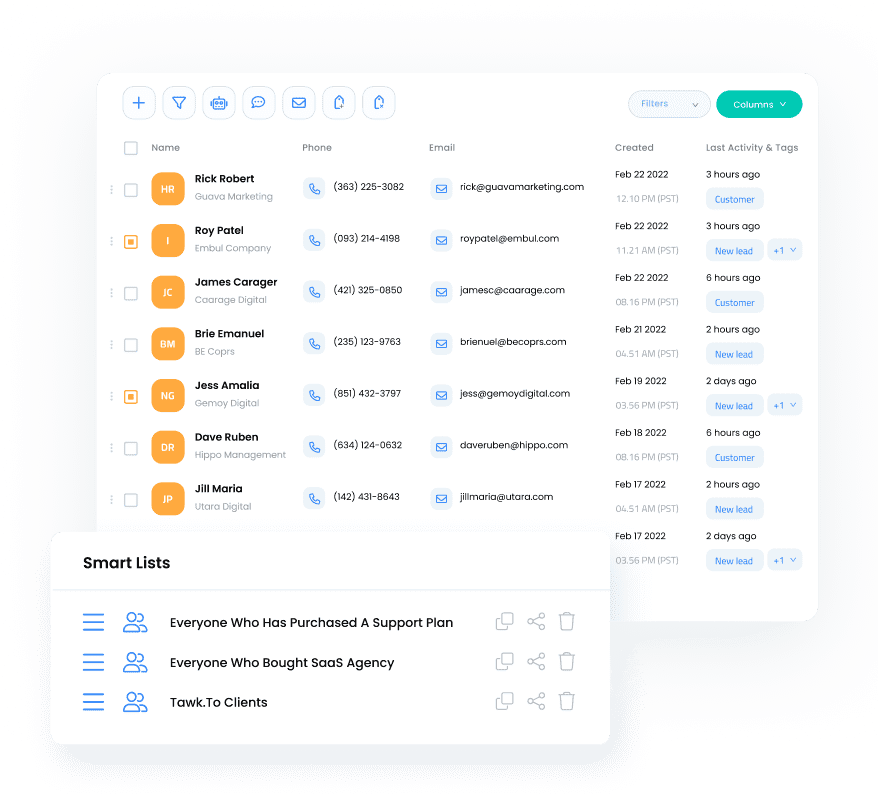
- Contact records that capture every interaction, purchase, and preference in a complete customer timeline
- Segmentation tools that let you group customers and tailor outreach based on behavior and value
- Pipeline tracking that gives visibility into where each customer relationship stands
The advantage of an all-in-one system is that your customer data, communication tools, and automation engine all live together. There is no need to stitch together five different platforms or manually sync data between them.
Frequently Asked Questions
What is the most cost-effective customer retention strategy for small businesses?
Automated email follow-ups consistently deliver the highest ROI for small businesses. Once set up, they run without manual intervention and can be personalized using CRM data. A simple post-purchase thank-you sequence combined with periodic check-in emails can significantly reduce churn without requiring additional staff or budget.
How do I know which customers are at risk of leaving?
Look for behavioral signals: decreased purchase frequency, lower engagement with your emails, unresolved support tickets, or longer gaps between interactions. CRM software helps by tracking these patterns automatically and flagging contacts who have gone quiet. Setting up alerts for inactivity (for example, no purchase in 90 days) lets you intervene before the customer is gone.
How often should I communicate with existing customers?
There is no universal cadence, but a good starting point for most small businesses is one to two touchpoints per month through a combination of email newsletters, personalized follow-ups, and relevant offers. The key is consistency and relevance. One valuable message per month outperforms four generic ones. Monitor unsubscribe rates and engagement metrics to find the right frequency for your audience.
Can small businesses compete with large companies on customer retention?
Absolutely. Small businesses have a natural advantage: the ability to provide genuine, personal attention that large corporations cannot replicate at scale. When a customer knows the owner by name and receives communication that reflects their specific history and needs, that creates a loyalty bond that no corporate loyalty program can match. The key is using tools like CRM automation to maintain that personal touch as your customer base grows.
Ready to Improve Your Customer Retention?
SMBcrm gives you the unified inbox, automated workflows, and customer insights you need to keep customers coming back --- all in one platform built for small businesses.