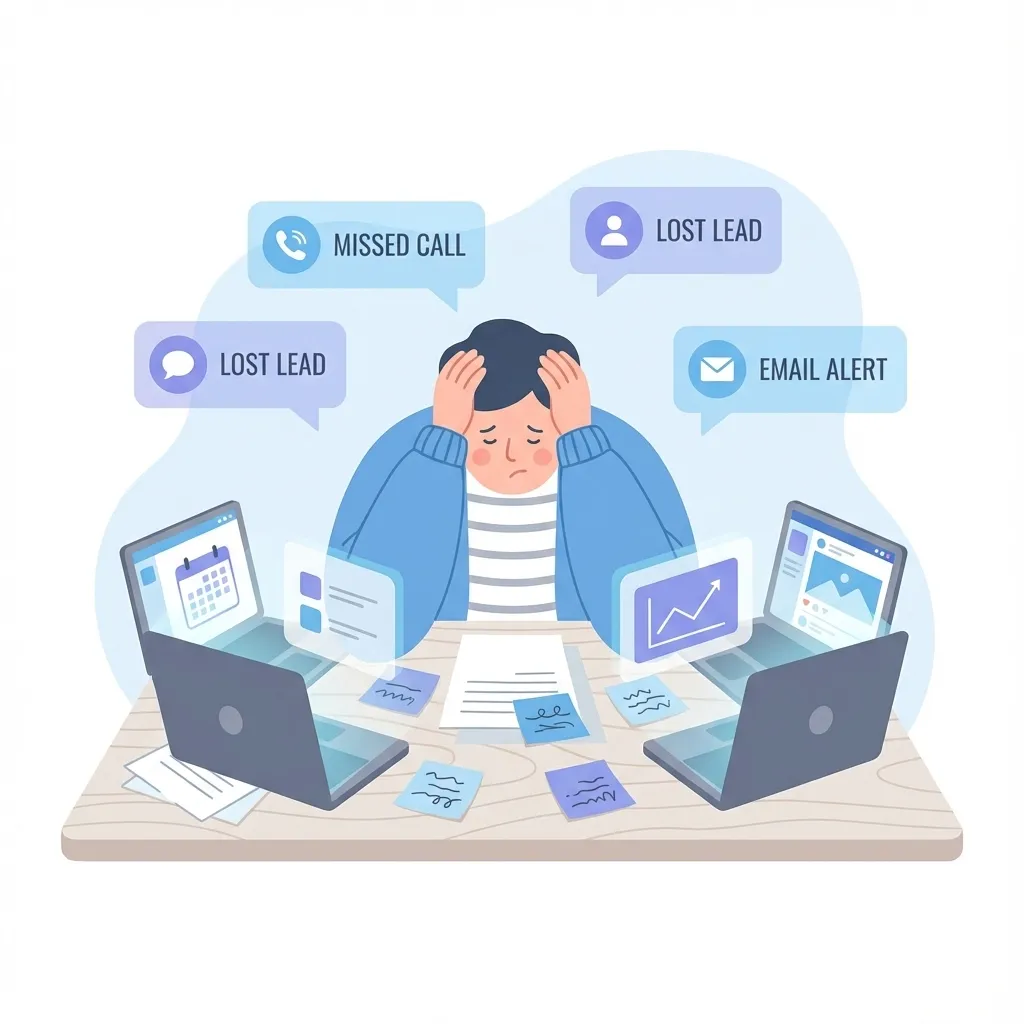
You generated a lead. They filled out a form, replied to an ad, or downloaded a resource. And then… nothing happened. No call, no email, no follow-up of any kind. That lead went cold, moved on, and signed with a competitor who simply showed up.
This is not a rare occurrence. It is the default outcome for most small businesses that lack a structured sales follow-up strategy. The data is clear: the overwhelming majority of leads are not lost because the product was wrong or the price was too high. They are lost because nobody followed up consistently.
This guide walks through a complete follow-up framework — the timing, the channels, the messaging, and the automation — so you can systematically convert more of the leads you are already generating.
Why Follow-Up Is the Highest-Leverage Activity in Sales
The statistics around sales follow-up are striking, and they have remained consistent across multiple studies over the years:
- 80% of sales require at least five follow-up contacts after the initial meeting or inquiry
- 44% of sales reps give up after just one follow-up attempt
- Leads contacted within the first five minutes are 21 times more likely to enter the pipeline than those contacted after 30 minutes
- The average prospect says “no” four times before saying “yes”
These numbers reveal a massive gap between what effective selling requires and what most teams actually do. The reps and businesses that win are not necessarily better at pitching — they are better at showing up again and again, with relevant value, until the prospect is ready to move forward.
For small businesses especially, where every lead carries real acquisition cost, abandoning a prospect after one or two touches is the most expensive mistake you can make. If you are still building out how leads flow through your pipeline, our guide on CRM and sales pipeline management covers the structural foundation that makes follow-up work.
The Ideal Follow-Up Timeline
Timing is everything in follow-up. Reach out too soon and you feel pushy. Wait too long and the prospect forgets you exist. The following timeline balances persistence with professionalism, giving each touchpoint a distinct purpose so you are never just “checking in.”
| Touchpoint | Timing | Channel | Purpose |
|---|---|---|---|
| Touch 1 | Within 5 minutes | Phone + Email | Immediate response while intent is high |
| Touch 2 | Day 1 (same day) | SMS | Quick follow-up confirming next steps |
| Touch 3 | Day 3 | Share a relevant resource or case study | |
| Touch 4 | Day 7 | Phone | Personal check-in, address questions |
| Touch 5 | Day 14 | Provide social proof or testimonial | |
| Touch 6 | Day 21 | SMS or Email | Re-engage with a new angle or offer |
| Touch 7 | Day 30 | Final “breakup” message |
A few important notes about this timeline:
Speed matters most at the beginning. The first touch should happen within minutes, not hours. Research from Lead Response Management found that the odds of qualifying a lead drop by 10x if you wait longer than five minutes after the initial inquiry. If you cannot call immediately, an automated email or SMS acknowledgment buys you time.
Vary the channel with each touch. Sending seven emails in a row trains the prospect to ignore you. Mixing phone, email, and SMS keeps your outreach fresh and increases the chance of catching them on their preferred channel.
Every touch must deliver value. “Just checking in” and “circling back” are not strategies. Each follow-up should include something useful — a relevant article, a specific answer to a question they raised, a case study from a similar business, or a concrete next step.
Choosing the Right Channel for Each Follow-Up
Not every channel works equally well at every stage of the follow-up sequence. A multi-channel communication platform that unifies email, SMS, and phone in one inbox helps you deploy each channel strategically.
Email is the backbone of most follow-up sequences. It is low-friction for the recipient, easily automated, and provides a written record of the conversation. Use email for:
- Sending detailed information, attachments, or links
- Follow-ups that require longer-form messaging
- Nurture content like case studies, guides, or comparison resources
- The formal “breakup” message at the end of a sequence
For a deeper look at connecting your email workflows to your CRM, see our guide on CRM email integration.
SMS
Text messaging has the highest open rate of any channel — consistently above 95%. That makes SMS ideal for short, time-sensitive communications. Use SMS for:
- Confirming appointments or next steps
- Quick reminders before a scheduled call
- Brief re-engagement messages (“Hey [Name], still interested in solving [problem]?”)
- Following up after a voicemail
Keep texts concise and conversational. Long paragraphs in a text message feel intrusive. Our post on SMS marketing and lead conversion covers best practices for using text messaging in your sales process.
Phone
The phone remains the most effective channel for having real conversations, handling objections, and building rapport. However, it also has the highest friction — both for the rep making the call and the prospect answering it. Use phone calls for:
- The initial response to a hot lead (within five minutes)
- Mid-sequence check-ins where you need to gauge interest
- Addressing complex questions or concerns
- Moving a deal from consideration to decision
If a call goes to voicemail, leave a brief message and follow up with an email or text. The combination of voicemail plus a written touchpoint dramatically increases callback rates compared to either one alone.
Follow-Up Message Templates
Having templates ready eliminates the blank-page problem that causes reps to delay follow-up. Customize these to fit your business, but keep the structure intact.
Template 1: Immediate First Response (Email)
Subject: [First Name], here is what happens next
Hi [First Name],
Thanks for reaching out about [specific topic or product]. I wanted to connect right away so you know your inquiry did not disappear into a black hole.
Based on what you shared, I think [one specific way you can help] would be most relevant to your situation. I have attached [resource/case study/overview] to give you a head start.
Would [specific day] at [specific time] work for a quick 15-minute call? I would love to learn more about what you are looking for and see if we are a good fit.
Best, [Your Name]
Why it works: Acknowledges their action, delivers immediate value, and proposes a specific next step.
Template 2: Value-Add Follow-Up (Day 3 Email)
Subject: Quick resource for [their specific challenge]
Hi [First Name],
I came across this [article/case study/guide] and thought of your situation with [specific challenge they mentioned].
[Link or brief summary of the resource]
[One specific insight from the resource and how it applies to them.]
Happy to walk through how this could apply to your business whenever you have a few minutes.
[Your Name]
Why it works: Positions you as a resource, not a salesperson. Demonstrates that you listened and are thinking about their needs.
Template 3: Social Proof Follow-Up (Day 14 Email)
Subject: How [similar company/industry] solved [their problem]
Hi [First Name],
I know timing is everything, so I wanted to share a quick win from a [similar business type] that was dealing with the same [challenge] you mentioned.
[Two to three sentences about the result — keep it specific and quantified if possible.]
I would love to explore whether we can deliver something similar for [their company]. Worth a quick conversation?
[Your Name]
Why it works: Social proof from a peer is one of the strongest motivators for prospects sitting on the fence.
Template 4: The Breakup Email (Day 30)
Subject: Should I close your file?
Hi [First Name],
I have reached out a few times and have not heard back, so I want to be respectful of your time. I am going to assume the timing is not right and close out your file on my end.
If anything changes down the road, I am always here. Just reply to this email and we can pick up where we left off.
Wishing you the best with [their goal or challenge], [Your Name]
Why it works: The breakup email consistently produces the highest reply rates of any follow-up message. By removing pressure and signaling that you are about to stop reaching out, you create urgency without being aggressive. Many prospects who have been silently reading your emails will respond to this one.
Automating Your Follow-Up Sequences
Manual follow-up is unsustainable at any meaningful volume. If you have more than a handful of active leads at a time, some will inevitably fall through the cracks unless the process is automated.
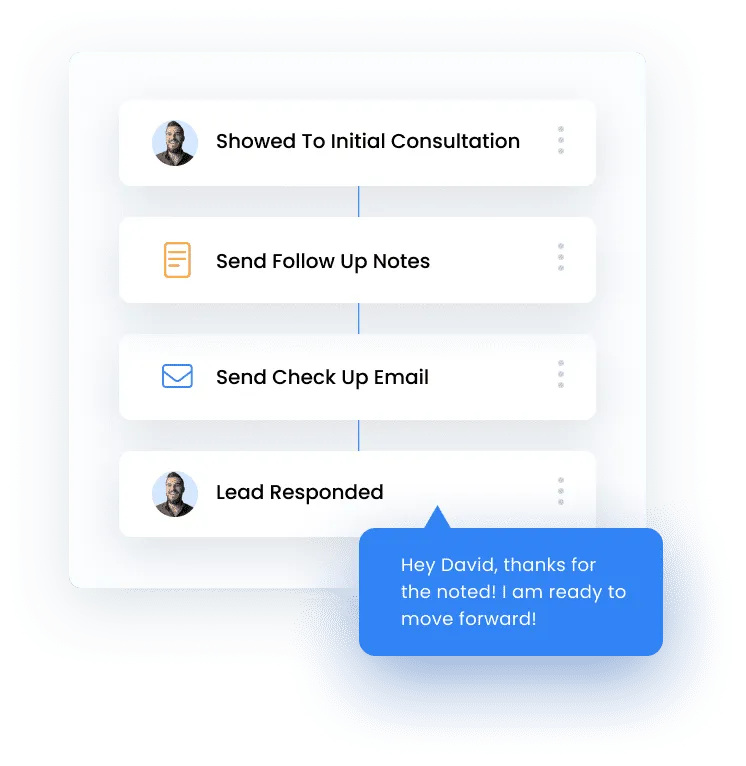
Automated follow-up sequences (sometimes called drip campaigns or cadences) use your CRM’s workflow automation to execute the timeline above without requiring a rep to remember each step. Here is what automation handles:
- Triggering the sequence when a lead enters your pipeline (form submission, ad click, referral logged)
- Sending emails and SMS messages at the intervals you define
- Pausing the sequence when a prospect replies, books a meeting, or takes another qualifying action
- Alerting your team when it is time for a phone call or personal touch
- Moving leads between stages based on engagement or lack thereof
The key to effective automation is building sequences that feel personal, not robotic. Use merge fields for names, reference the lead’s specific interest or source, and write in a conversational tone. If your automated emails read like marketing blasts, they will be ignored like marketing blasts.
For small businesses, a CRM with built-in workflow automation eliminates the need to stitch together separate tools for email, SMS, and task management. Our guide on CRM workflow automation covers how to set up these sequences from scratch, including templates you can implement in an afternoon.
How SMBcrm Handles Follow-Up Automation
SMBcrm provides multi-channel follow-up sequences that coordinate email, SMS, and phone tasks within a single workflow builder. When a new lead enters your pipeline, the system can automatically launch a follow-up sequence tailored to the lead source, assign phone call tasks to the right rep at the right time, and pause the entire sequence the moment a prospect responds. Because everything lives in one platform — contacts, communication history, pipeline stages, and automation — nothing gets lost between tools.
Tracking and Measuring Follow-Up Effectiveness
A follow-up strategy is only as good as your ability to measure and refine it. Track these metrics to understand what is working and where leads are dropping off:
Key Metrics to Monitor
- Response rate by touchpoint — Which touch in your sequence generates the most replies? If touch five consistently outperforms touch two, examine what you are saying differently and apply that insight earlier in the sequence.
- Time to first response — How quickly does your team follow up with new leads? Track this in hours or minutes, not days.
- Conversion rate by channel — Are your email follow-ups or SMS messages driving more booked meetings? Allocate effort toward what works.
- Sequence completion rate — What percentage of leads make it through your entire follow-up sequence versus dropping off or converting early? This tells you whether your sequence length is appropriate.
- Pipeline velocity — How quickly do leads move from first contact to closed deal? Effective follow-up should compress this timeline over successive months.
Not every lead deserves the same level of follow-up intensity. Lead scoring helps you prioritize which prospects get your most aggressive sequences and personal attention, and which ones receive a lighter automated touch. Our guide on lead scoring for small businesses explains how to build a scoring model that directs your follow-up resources where they will have the greatest impact.
Refining Your Sequences Over Time
Review your follow-up performance monthly. Look for patterns:
- Are leads from a specific source converting better with SMS-heavy sequences?
- Is there a consistent drop-off point where prospects stop engaging?
- Do certain subject lines or messaging angles outperform others?
Use these insights to adjust timing, swap out underperforming templates, and test new approaches. Even small improvements in follow-up conversion rates compound significantly over time because you are extracting more revenue from leads you have already paid to acquire.
Frequently Asked Questions
How many follow-up attempts should I make before giving up?
Seven touches across 30 days is a solid benchmark for most B2B and high-value B2C sales. Research consistently shows that the majority of conversions happen between the fifth and twelfth contact. If you are giving up after two or three attempts, you are leaving significant revenue on the table. That said, respect clear opt-outs — if a prospect explicitly says they are not interested, remove them from the sequence.
What is the best time of day to follow up with leads?
For phone calls, late morning (10:00-11:30 AM) and late afternoon (3:30-5:00 PM) in the prospect’s local time zone tend to produce the highest connect rates. For email, Tuesday through Thursday mornings see the strongest open rates. SMS performs well during business hours, particularly mid-morning. However, the most important factor is not the time of day — it is the speed of your initial response after the lead comes in.
Should I use the same follow-up sequence for every lead?
No. Your follow-up should vary based on lead source, expressed interest level, and where the prospect sits in their buying journey. A lead who requested a demo is further along than someone who downloaded a general guide, and your messaging should reflect that. Build two to three sequence variants — one for hot leads, one for warm leads, and one for cold or re-engagement leads — and route prospects into the right sequence based on their initial action.
How do I follow up without sounding desperate or pushy?
The key is to lead with value in every touchpoint. Instead of “just checking in,” share something useful — an industry insight, a relevant case study, a specific answer to something they mentioned. Frame your follow-ups around helping them solve their problem, not closing your deal. When the prospect sees each message as genuinely helpful rather than self-serving, persistence is welcomed rather than resented.
Ready to Never Miss a Follow-Up Again?
SMBcrm automates your entire follow-up sequence across email, SMS, and phone — so every lead gets the right message at the right time without anything slipping through the cracks.