Ask “how much does a CRM cost?” and you’ll get answers from free to $500 per technician per month — and both are technically true. The honest answer depends on three things: the pricing model, what’s actually included, and the fees that don’t appear on the pricing page.
We checked the published pricing of the most popular small-business CRMs in June 2026, with select rates re-verified in September 2026. Below: what each model actually costs, where budgets quietly blow up, and which questions to ask before a “cheap CRM” turns into a full software stack.
The three CRM pricing models
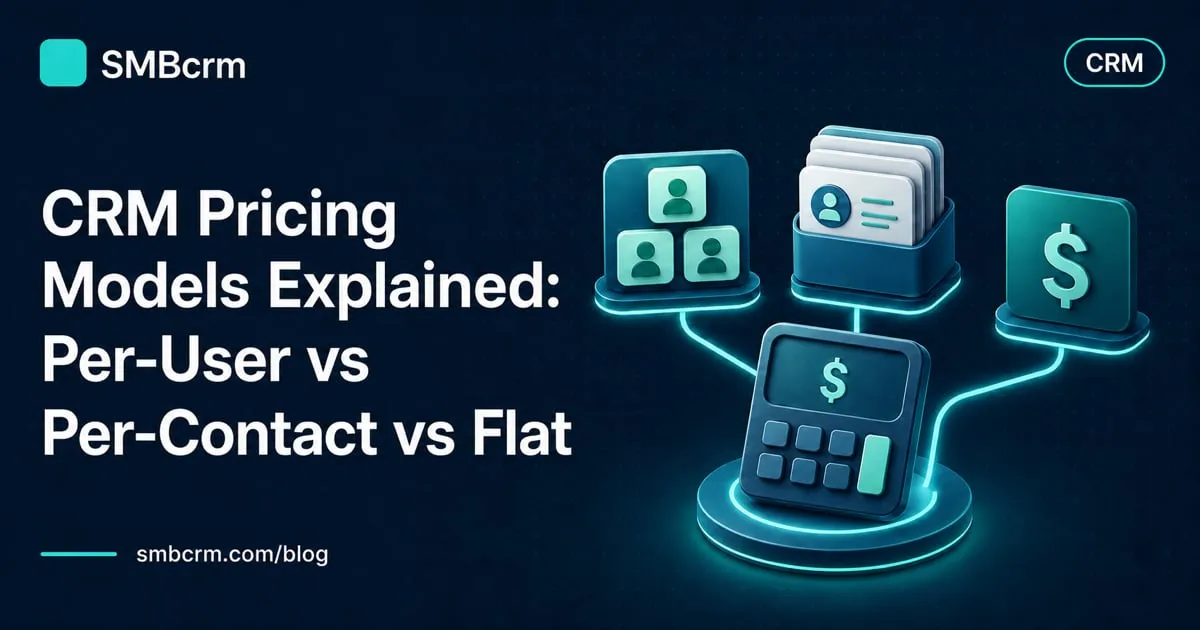
Every CRM bill is built on one of three meters:
1. Per user. You pay for every person with a login. Pipedrive runs published per-seat plans, Freshsales starts from $9/user/month, Zoho CRM runs $14–$52/user/month on its annual tiers, and Less Annoying CRM is a flat $15/user/month. Cheap for a two-person team, but the bill grows every time you hire — and these tools are generally sales-only, so marketing costs extra, elsewhere.
2. Per contact. You pay for the size of your database. Keap starts at $299/month and includes a fixed contact/user base on its public plan. ActiveCampaign and HubSpot’s Marketing Hub contact model scale by contacts, tier, and email send limits. With per-contact pricing, growing your audience grows your invoice — before you’ve sent a single campaign.
3. Flat rate. You pay one price regardless of team or list size. SMBcrm is built this way: $97/month (2 users, unlimited contacts) or $297/month (unlimited users, unlimited contacts), with transparent usage-based rates for things like SMS and email volume instead of seat or contact meters.
What popular CRMs actually cost (June 2026)
| Platform | Published price | The catch |
|---|---|---|
| Less Annoying CRM | $15/user/mo | Contacts + pipeline only — no campaigns, SMS, or automation |
| Freshsales | $9–$59/user/mo | Marketing requires the separate Freshmarketer product |
| Pipedrive | Per-user tiers | Email campaigns are a paid add-on; no native SMS |
| Zoho CRM | $14–$52/user/mo | The “all-in-one” experience means assembling many Zoho apps |
| HubSpot | Free–$890+/mo | Real marketing automation lives in Marketing Hub Pro (~$890/mo) |
| ActiveCampaign | Contact-based tiers | Scales with contacts, channels, and add-ons |
| Keap | $299/mo + $500 setup | 1,500 contacts included; $39/extra user; overage billing |
| Jobber | $49–$699/mo monthly; annual promos lower | Marketing features are $29–$99/mo add-ons unless bundled; user caps per tier |
| ServiceTitan | ~$245–$398/tech/mo (est.) | Quote-only; implementation estimated at $5K–$50K over 2–12 months |
| SMBcrm | $97–$297/mo flat | Usage rates for SMS/email volume (credit included monthly) |
Pricing changes often, and vendors run limited promotions. Useful current source pages: Pipedrive pricing, Freshsales pricing, Zoho CRM pricing, HubSpot marketing contacts, ActiveCampaign pricing, Keap pricing, Jobber pricing, Housecall Pro pricing, and Less Annoying CRM pricing.
The hidden costs that wreck CRM budgets
The sticker price is rarely the real price. Watch for four budget-breakers:
Implementation fees. Keap’s onboarding package is commonly quoted around $500. ServiceTitan implementations can run thousands of dollars and take months. Ask directly: “What does it cost to go live?” (With SMBcrm, onboarding and unlimited group training are included on every plan.)
The add-on menu. Jobber’s plan price looks reasonable until you add the Marketing Suite ($99/mo), the AI Receptionist ($29/mo), or Pipeline ($49/mo). Pipedrive’s email tool is an add-on. Price the features you’ll actually use, not the base tier.
Seat creep. Per-user pricing is a tax on hiring. A 5-person team on Pipedrive Growth is about $245/month billed monthly, and that plan already includes automations and a meeting scheduler, though not email campaigns. The same team on Keap pays $117/month just in extra-user fees.
The shadow stack. This is the big one. A “cheap” sales-only CRM usually implies a separate email platform, texting app, booking tool, review manager, and form builder. Five subscriptions, five logins, five support teams — service businesses routinely spend $300+/month across the stack without noticing, because no single line item looks expensive. That is why all-in-one pages like SMBcrm alternatives and CRM comparison pages should be evaluated by total workflow, not just base subscription price.
So what should a small business budget?
For a team of 2–10 people that wants the full acquisition engine — CRM, email, SMS, booking, payments, reviews — realistic 2026 budgets look like:
- DIY stack of point tools: $150–$400+/month, plus the integration time to keep it glued together
- Suite platforms (HubSpot-style): entry tiers are cheap, but the jump to real automation lands around $890+/month
- All-in-one flat platforms: $97–$297/month, all channels included
One more number worth knowing: leads contacted within 5 minutes are 21x more likely to qualify than leads contacted after 30 minutes (MIT/InsideSales Lead Response Study, cited by Harvard Business Review). Whatever you pay, the CRM that actually does the follow-up for you is the one that pays for itself.
Questions to ask before you sign
- What’s the total monthly cost with every feature we need turned on?
- What happens to the price when we hire two people? When our list doubles?
- Is there an implementation or onboarding fee? What support is included after?
- What are the texting and email sending costs at our volume?
- If it doesn’t work out, what does leaving look like — export options, contracts, refunds?
That last one matters more than people think. Month-to-month terms and a real money-back guarantee tell you the vendor expects to earn your business every month. (Every SMBcrm plan carries a 60-day money-back guarantee — and we migrate your data from your current CRM free.)
CRM cost FAQ
What is a realistic CRM budget for a small business in 2026?
For basic contact tracking, expect $15–$60 per user per month. For a complete acquisition stack — CRM, forms, email, SMS, booking, payments, reviews, and automation — a realistic budget is usually $150–$400/month with point tools, $890+/month on suite platforms, or $97–$297/month on a flat all-in-one platform like SMBcrm.
Is free CRM software really free?
Free CRM tiers can be useful for contacts, basic pipelines, and very small teams. They usually stop being “free” when you need marketing automation, higher email volume, extra seats, SMS, reporting, quoting, or support. Treat free plans as a trial of workflow fit, not as the final cost of running sales and marketing.
Which CRM pricing model is safest for a growing team?
Flat-rate pricing is usually safest when your contact list and team are both growing. Per-user pricing is predictable for very small teams, but it penalizes hiring. Per-contact pricing can work for small lists, but it makes audience growth a recurring cost. Usage-based fees are easiest to manage when they apply only to metered channels like SMS, email, voice, or AI usage.
How do I compare CRM prices fairly?
Build a one-page total cost of ownership sheet. Include base subscription, users, contacts, onboarding, implementation, email sends, SMS, phone numbers, booking, forms, payment fees, review tools, support, and any required annual contract. Then compare that full cost against the workflows you actually need, not against a homepage starting price.
Ready to see flat-rate pricing in action?
One platform, one bill, unlimited contacts — backed by a 60-day money-back guarantee.
Get started or schedule a demo to walk through it with a human.
Explore this in SMBcrm
Compare the plan and the usage behind it.
Review plan features alongside phone, messaging, and AI usage. Include setup and the specialist tools you still need in your comparison.
Compare SMBcrm plans