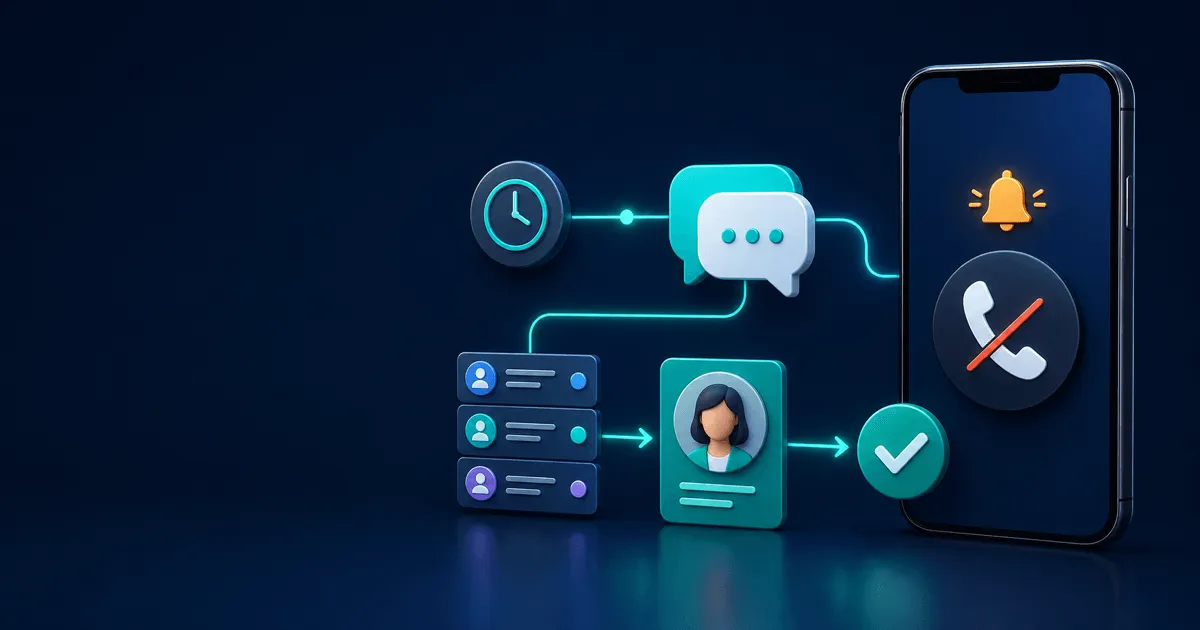
A missed call can be a new job, a customer checking an appointment, or a spammer. Multiplying every unanswered ring by your average invoice gives you a large number, but a poor basis for deciding whether to hire someone or buy software.
For missed calls, small business owners need two answers: which callers needed help they did not receive, and how much additional gross profit a better response could produce. Start with your call log, then choose coverage that fits the gaps.
What the evidence can support
The widely repeated missed-call headline traces to a 411 Locals post published in January 2016. The company says it monitored 85 businesses across 58 industries for 30 days. It separates calls answered from calls forwarded to voicemail and calls receiving no response.
That page does not disclose total call volume, how businesses were selected, the fieldwork dates, or whether spam, repeat attempts, and after-hours calls were excluded. Its headline combines voicemail with no response. We are leaving that percentage out of this guide because the published method cannot establish a current, representative small-business missed-call rate.
A more recent Invoca benchmark, released in June 2025, analyzed anonymized contact-center data from over 60 million calls across nine industries. It found that 61% of callers spoke with a person. Invoca explicitly notes that calls without a live answer can include situations where automated systems resolved the caller’s need.
This is vendor research covering its observed contact-center population, not a random sample of local service businesses. It supports measuring answer rates and outcomes separately. It does not tell a two-person plumbing business what its own losses are.
Define a miss before pricing it
Use one primary outcome per call attempt, with separate tags for timing and purpose:
| Outcome | What to record |
|---|---|
| Live answer | A person handled the call; record whether the need was resolved. |
| Automated resolution | A system completed the request, such as providing information or a confirmed booking. |
| Voicemail | Record whether a message was left and whether follow-up resolved it. |
| Abandoned call | The caller disconnected before help; record queue or hold time. |
| Ring-out or failed routing | Nobody answered, or the configured destination failed. |
“After hours” is a timing tag, not an outcome. “Unqualified” is a purpose classification: spam, wrong numbers, vendors, or requests outside your service area. An existing customer’s call can matter operationally without being a new-sale opportunity.
Group repeated attempts from the same prospect around the same request. If someone called three times and then booked online, counting three lost jobs would overstate the problem. Keep both attempt-level coverage and request-level outcomes so a better answer rate does not hide poor service.
Build a cost model from your numbers
Review a month of calls, including a busy week. Follow unresolved requests through callbacks, messages, bookings, and completed jobs. For calls you cannot qualify, use a range rather than assuming they match answered callers.
Use these inputs for one consistent period:
| Input | Illustrative monthly assumption |
|---|---|
| Eligible inbound requests, after removing duplicates and obvious noise | 400 |
| Initial successful-resolution rate (person or automation) | 75% |
| Qualified opportunity share of unresolved requests | 50% |
| Completed-sale rate after reaching a qualified caller | 40% |
| Average gross profit per completed sale | $300 |
| Current recovery rate of unresolved qualified requests | 20% |
| Proposed recovery rate | 50% |
| Additional staffing or software cost | $900 |
These are invented planning assumptions, not measured SMBcrm results or industry averages. The resolution rate counts successful automation alongside live answers; an answer that leaves the request unresolved should not count as success.
The reproducible calculation is:
- Unresolved requests = volume × (1 − resolution rate): 400 × 0.25 = 100.
- Qualified unresolved opportunities = unresolved requests × qualified share: 100 × 0.50 = 50.
- Gross profit available before recovery = qualified opportunities × sale rate × gross profit: 50 × 0.40 × $300 = $6,000.
- Gross profit still at risk after current recovery = $6,000 × (1 − 0.20) = $4,800.
- Additional gross profit from better recovery = $6,000 × (0.50 − 0.20) = $1,800.
- Net monthly contribution after added cost = $1,800 − $900 = $900.
Under these assumptions, the system needs a 15-percentage-point recovery improvement to cover its added cost: $900 ÷ $6,000 = 0.15. If improvement is only 10 points, it produces $600 against $900 of cost.
Use completed sales if you multiply by gross profit per job. If your data stops at bookings, include the booking-to-completed-sale rate too. Customer lifetime value is another possible input, but use contribution value over a stated horizon and account for retention and fulfillment costs. Do not mix lifetime revenue with monthly operating costs and call the result profit.
Recovery means a qualified caller was reached and re-engaged; conversion remains a separate step. Include existing callbacks in the baseline so the proposed system does not claim credit for business you already recover. Add setup, training, usage, and ongoing review costs. If your crews have no spare capacity, recovered inquiries may require additional labor before they produce value.
Find the coverage failure
Break unresolved calls down by hour, day, destination, and outcome. Check whether business hours match your advertised availability. Look for lunch gaps, simultaneous calls during booking peaks, long menus, excessive hold time, or a forwarded number that reaches another voicemail box.
For HVAC businesses, a useful test is whether urgent inquiries reach the designated on-call person. For plumbing businesses, check whether calls made while the owner is on a job receive a defined response. These are operating tests, not assumptions about either industry’s missed-call rate.
A callback list also needs an owner. Set a response target the team can meet, record attempts, and escalate overdue requests. A notification that everyone sees can still leave nobody responsible.
Choose coverage by the job it must do
| Response choice | Best use | Tradeoff and failure to test |
|---|---|---|
| Routing and schedules | Getting callers to available staff | Wrong destinations or overlapping rules can create loops; test overflow and after-hours paths. |
| Voicemail with callback standards | Detailed requests that can wait | Callers may leave no message; give a realistic callback window and assign an owner. |
| Missed-call text-back | Offering an eligible caller another way to respond | Consent, opt-outs, delivery failure, and repeated-call duplicate texts need controls. |
| Web booking | Routine appointments with clear eligibility | A confirmed slot may still be unsuitable; use service-area and appointment rules. |
| Human answering service | Nuanced intake and callers needing judgment | Check training, access limits, escalation coverage, and the actual quote for your workload. |
| AI receptionist | Bounded questions and structured intake | Test incorrect answers, misunderstood names, unavailable integrations, and failed transfers. |
AI choices include a standalone answering service, an agent connected to your CRM, or an overflow agent backed by people. Compare where call notes go, which actions the agent can take, who maintains its information, and what happens when it cannot finish. Ask for a demonstration using your own difficult scenarios.
Give any receptionist a narrow authority boundary. Approved information and intake questions are safer starting points than open-ended advice or binding quotes. Complaints, sensitive requests, unusual pricing, and uncertain answers should have a human escalation path. Emergency language needs an approved script; it should never imply that a routine intake queue provides emergency response.
Test a caller asking for a person, an unavailable calendar, a noisy connection, a full transfer destination, and a request outside your services. The fallback should create an owned callback task or another approved response, not silently end the interaction.
Set consent and privacy rules before automation
A phone call should not be treated as blanket permission for promotional texts. Twilio’s current messaging policy requires consent appropriate to message type, evidence of consent, sender identification, and a way to withdraw it. Review your provider’s rules for the exact text-back flow; a registration approval does not replace consent. Honor STOP and other applicable opt-out requests, and suppress further messages accordingly.
Inbound answering and outbound AI callbacks need separate review. The FCC’s February 2024 announcement explains that AI-generated voices fall within TCPA artificial-voice restrictions, including prior express written consent for telemarketing robocalls. Do not assume an inbound inquiry authorizes every automated outbound use.
Recording rules also depend on jurisdiction and circumstances. California Penal Code section 632 addresses recording confidential communications without all parties’ consent. Have qualified counsel review applicable locations, notices, and consent before enabling recording or transcription.
As an operating standard, identify the business and disclose when callers are speaking with an automated assistant. Review applicable disclosure requirements separately. Limit collected data, restrict access to recordings and transcripts, set retention periods, and check vendor terms and sector-specific obligations. An AI setting does not establish privacy compliance.
Where SMBcrm fits
SMBcrm’s communication tools include a shared inbox, phone features, and missed-call text. Its automation tools support follow-up workflows, while Voice AI within its AI features can answer questions and route conversations.
Those capabilities can form part of a response system. They still need business hours, approved information, consent controls, an escalation owner, and testing. Review current usage rates and plan terms against your expected workload rather than assuming every call or AI action is included.
Pilot one coverage gap first. Compare unique qualified requests, recovery, completed sales, response time, failed handoffs, and total cost against the baseline. Keep the system only if it improves the outcome you chose. SMBcrm does not replace trained judgment or guarantee recovered revenue.
Sources and SMBcrm feature references checked October 5, 2026. Illustrative calculations are planning examples.
Build a response system you can measure
Explore SMBcrm with its 60-day money-back guarantee, and review the plan terms before choosing your setup.