Business software is supposed to make your life easier.
That’s the promise, anyway. Streamline operations. Boost efficiency. Save time and money.
But what if I told you the opposite is happening?
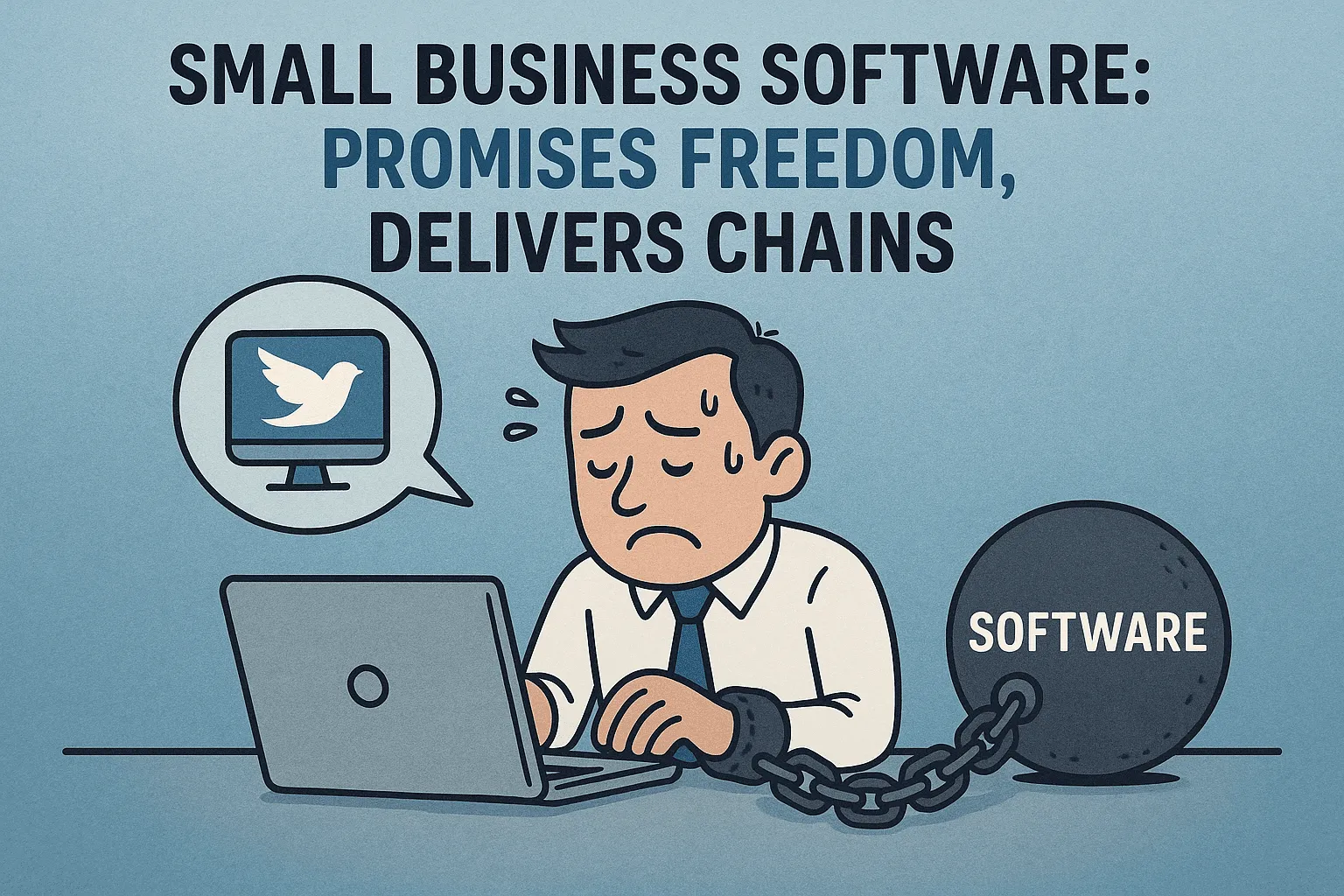
After running a marketing agency for seven years and working with hundreds of small businesses, I’ve watched software systematically destroy the companies it was meant to help. The very tools designed to simplify operations are creating complexity. The platforms built to save money are draining bank accounts. The systems promising freedom are creating digital prisons.
Let me show you exactly how this happens.
That restaurant owner thought he was being smart.
He found the “best” tool for each function. Separate systems for reservations, inventory, payroll, marketing, customer reviews, and accounting. The monthly cost? $800.
But the real cost was brutal.
His staff spent 2-3 hours daily moving data between systems, double-entering customer information, and trying to figure out why numbers didn’t match. He hired a part-time person just to manage logins and integrations.
His $800 monthly software cost was actually $2,000 when you factor in labor. He was paying more for software complexity than rent.
The Invisible Cost Spiral
Most business owners think they spend 3-5% of revenue on software. The reality? Many spend 15-20%.
It starts innocent. One $29 monthly tool. Then a $49 solution. Then a $99 platform. Before you know it, you’re staring at a $500+ monthly bill.
The costs become invisible through clever psychology. The marketing automation tool gets buried in the marketing budget. The scheduling system hides in operations. The CRM — a tool whose core value lies in centralizing customer relationships — disappears into sales expenses.
Nobody tracks total technology spend as a single line item.
Software companies show monthly costs, not annual commitments. A $97 monthly tool sounds reasonable until you realize you’re committing $1,164 per year. That’s before the “premium features” upsells hit six months later.
I’ve seen business owners discover their actual software spend during audits. One thought he was paying $200 monthly. The real number? $847, including tools employees had signed up for with company credit cards.
Digital Handcuffs
The shock of discovering true costs is just the beginning.
Then comes panic. You can’t cancel everything overnight because your business depends on these systems. Customer data is trapped in one platform, payment processing in another, your team trained on three different interfaces.
When you try to escape, the real trap reveals itself.
Getting your data out costs money. One client wanted to leave a $200 monthly CRM. The data export fee? $500. Plus $300 to clean it up for the new system. He needed $800 just to escape a tool that wasn’t working.
More than 80% of data migration projects fail to meet deadlines or stick to budget. Software companies make it easy to get in and expensive to get out.
The Enterprise-Down Problem
Software companies think small businesses are just smaller enterprises. They build enterprise features, then try making them “affordable” with lower price points.
This misses everything.
A small business owner doesn’t want 47 reporting dashboards. They want to know if they’re making money this month. They don’t need advanced workflow automation. They need phone calls, texts, and emails in one place so they can respond to customers.
Software companies optimize for feature lists and demo presentations. Small businesses need tools that work without thinking about them.
The dirty secret? Most small businesses would be better off with simpler tools that do fewer things really well, rather than comprehensive platforms that do everything poorly. Knowing how to choose the right CRM can save you from this trap entirely.
Time Bankruptcy
The financial cost is obvious. The time cost is devastating.
Business owners spend weekends trying to make “simple” software work. Migration processes can take months or years, with employees spending time on integration projects instead of serving customers.
The emotional toll is brutal. Successful business owners who can manage employees and handle difficult customers feel like failures because they can’t sync their email marketing with their contact list.
They’re embarrassed to admit they’re struggling. They think everyone else figured it out and they’re the only ones who don’t get it.
Instead of spending weekends with family, they’re hunched over laptops trying to make software work. The promise was more time and freedom. The reality is stolen personal time and peace of mind.
The Simplicity Solution
There’s a crucial distinction between “all-in-one” and “everything-in-one.”
Most platforms bolt together separate modules that barely talk to each other. You get the same fragmentation problem, just under one roof. A truly unified all-in-one CRM takes a fundamentally different approach.
True unification works differently. When a customer texts you, that conversation automatically connects to their contact record, purchase history, and scheduled appointments. You’re not switching between modules or wondering if data synced properly.
Small businesses need software that makes them feel organized and in control, not overwhelmed. They want to spend time serving customers, not learning new interfaces.
The solution isn’t more features. It’s clarity. One system that thinks like a small business owner thinks, where everything flows together naturally.
Because 45% of organizations exceed their software spending limits, the real competitive advantage isn’t having the most tools.
It’s having the right one.
One Platform That Actually Works Together
SMBcrm brings CRM, email, SMS, calling, calendars, invoicing, and automation into one unified system where everything connects automatically. No integrations to manage, no data gaps, no switching between tools.
Start your free trial and see what unified software feels like, or schedule a demo to get a personalized walkthrough.