You are running ads, publishing content, and driving traffic to your website — but how do you know if that traffic is actually converting? And more importantly, how do you know if your conversion rate is any good?
These are questions every small business owner asks eventually. The answer is not as straightforward as a single number, because “good” depends on your industry, traffic source, and what you are asking visitors to do. But there are clear benchmarks you can use to evaluate your performance — and proven strategies to improve it.
In this guide, we will cover what conversion rates actually measure, where yours should fall based on industry data, and what to do if you are coming up short.
What Is a Conversion Rate?
A conversion rate is the percentage of visitors who take a desired action on your website or landing page. That action could be filling out a contact form, booking a consultation, making a purchase, signing up for a newsletter, or any other measurable goal.
The formula is simple:
Conversion Rate = (Number of Conversions / Total Visitors) x 100
If 1,000 people visit your landing page and 30 fill out your form, your conversion rate is 3%.
What counts as a “conversion” depends on your business model. For a home services company, it might be a quote request. For a dental practice, it might be a new patient appointment. For a SaaS product, it might be a free trial signup. The metric itself is universal — the definition of success is what changes.
Average Conversion Rates by Industry
Before you can judge your numbers, you need context. Here are typical website conversion rates by industry based on aggregated data from multiple studies:
| Industry | Average Conversion Rate | Top Performers |
|---|---|---|
| Professional Services | 3.5% – 5.0% | 10%+ |
| Healthcare | 2.5% – 4.0% | 8%+ |
| Home Services | 3.0% – 5.0% | 12%+ |
| Real Estate | 2.0% – 3.5% | 7%+ |
| Legal | 3.0% – 5.5% | 10%+ |
| Financial Services | 2.5% – 4.0% | 8%+ |
| E-commerce | 1.5% – 3.0% | 5%+ |
| SaaS / Technology | 2.0% – 4.5% | 7%+ |
| Education | 3.0% – 5.0% | 9%+ |
A few things stand out. First, the averages cluster around 2% to 5% for most industries. Second, top performers consistently hit two to three times the average — which means there is significant room for improvement if you are sitting at or below the median.
The takeaway: if your website conversion rate is below 2%, something is likely broken. If you are between 2% and 5%, you are in the normal range but have room to grow. If you are above 5%, you are performing well — keep optimizing.
Conversion Rates by Traffic Source
Where your visitors come from dramatically affects conversion rates. Not all traffic is equal.
Organic Search (SEO): Typically converts at 2% – 5%. These visitors are actively searching for a solution, so intent is high. If your organic traffic converts poorly, the issue is usually page relevance — your content does not match what the searcher expected to find.
Paid Search (Google Ads, Bing Ads): Typically converts at 3% – 6%. Paid search visitors have high intent and you control the landing page experience. If conversions are low here, your ad copy and landing page may be misaligned. Check out our guide on landing page optimization for specific fixes.
Social Media (Organic): Typically converts at 0.5% – 2%. Social traffic is often casual — people clicking through from a feed, not actively searching for a solution. This is normal and expected.
Social Media (Paid Ads): Typically converts at 1% – 3%. Better than organic social because you are targeting specific audiences, but still lower than search because the visitor was not actively looking for you.
Email Marketing: Typically converts at 3% – 8%. Email consistently outperforms other channels because you are reaching people who already know your brand and opted in to hear from you. If your email marketing is not driving conversions, the issue is usually segmentation or offer relevance.
Referral Traffic: Typically converts at 3% – 6%. Visitors who arrive via a recommendation or referral are pre-qualified with social proof. A strong referral marketing program can be one of your highest-converting traffic sources.
Why Your Conversion Rate Might Be Low
If your numbers fall below the benchmarks above, here are the most common culprits.
1. Your Landing Page Does Not Match the Traffic Source
This is the number one conversion killer. If someone clicks an ad for “affordable CRM software” and lands on your homepage instead of a focused landing page about CRM pricing, they will bounce. Every traffic source should land on a page that directly addresses the visitor’s intent.
2. Your Call to Action Is Weak or Unclear
Visitors need to know exactly what to do and why they should do it. “Submit” is not a call to action — it is a command. “Get Your Free Quote in 60 Seconds” tells the visitor what they get and how quickly they will get it. The difference in conversion between a generic CTA and a specific one can be 30% or more.
3. Your Forms Ask for Too Much
Every additional form field reduces completions. If you are asking for name, email, phone, company name, company size, industry, budget, timeline, and preferred contact method just to book a demo, you are filtering out most of your potential leads. Start with the minimum you need to follow up — typically name, email, and phone. You can gather the rest during the conversation.
4. Your Page Loads Too Slowly
A one-second delay in page load time can reduce conversions by 7%. If your landing page takes more than three seconds to load, you are losing visitors before they even see your offer. Compress images, minimize scripts, and use a fast hosting provider.
5. You Are Not Building Trust
First-time visitors need reasons to trust you before they hand over their contact information. Customer testimonials, review badges, security indicators, and professional design all contribute to perceived trustworthiness. If your page lacks social proof, conversions will suffer.
For local businesses, online reviews are particularly powerful — a strong Google review profile can lift conversion rates across every channel.
6. No Mobile Optimization
More than 60% of web traffic now comes from mobile devices. If your landing pages and forms are not fully responsive and easy to complete on a phone, you are ignoring the majority of your audience.
How to Improve Your Conversion Rate
Now for the actionable part. These strategies are ordered by impact — start at the top and work your way down.
Start with Your Highest-Traffic Pages
Do not try to optimize everything at once. Identify the pages that get the most traffic and have the lowest conversion rates. Improving a page that gets 5,000 visits per month from 1% to 3% gives you 100 additional leads per month. That same improvement on a page with 200 visits gives you 4.
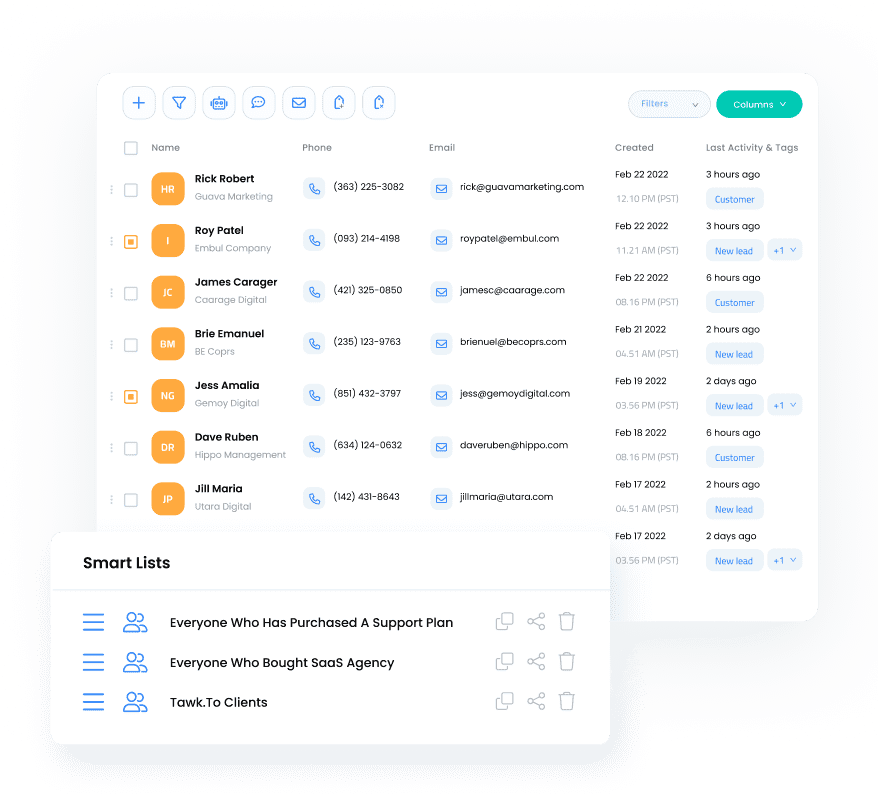
Use your CRM reporting tools to identify which pages and sources drive the most leads — then focus your optimization there.
Align Landing Pages with Traffic Sources
Create dedicated landing pages for each major traffic source or campaign. An ad for “pest control CRM” should land on a page about pest control solutions, not your generic homepage. The more specific the match between the ad (or search query) and the landing page, the higher your conversion rate.
If you are using lead capture tools to build forms and landing pages, make sure each form is tailored to the specific campaign driving traffic to it.
Write Better Headlines
Your headline is the first thing visitors read. It needs to communicate three things in under five seconds: what you offer, who it is for, and why they should care. Test different angles — problem-focused headlines (“Stop Losing Leads to Slow Follow-Up”) often outperform feature-focused ones (“Advanced Lead Management Software”).
Simplify Your Forms
Reduce form fields to the absolute minimum needed for a meaningful follow-up. For most service businesses, name and phone number or email is enough. You can always qualify leads further through your sales follow-up process once they are in your pipeline.
Add Social Proof Near Your CTA
Place customer testimonials, star ratings, or case study snippets directly above or beside your call-to-action button. Social proof at the point of conversion reduces anxiety and increases follow-through. An online reputation management strategy that generates consistent reviews gives you a steady supply of social proof to use across your site.
Use Urgency and Specificity
Generic offers convert poorly. “Contact us” is vague. “Get a free 15-minute strategy call — only 5 slots available this week” creates both specificity and urgency. Even small changes to CTA copy can produce measurable lifts.
Implement Follow-Up Automation
Conversion does not end at the form submission. What happens in the first five minutes after a lead converts can determine whether they become a customer or go cold. Set up automated workflows that trigger an immediate confirmation email, a text message, and a task for your sales team to call within five minutes.
Businesses that respond to leads within five minutes are 100x more likely to make contact than those that wait 30 minutes. Your CRM should handle this automatically.
Test Continuously
Run A/B tests on your highest-impact elements: headlines, CTA button text, form length, page layout, and hero images. Test one variable at a time so you can attribute results clearly. Even a 0.5% improvement on a high-traffic page compounds over months and years.
What About Conversion Rate by Page Type?
Different page types have different baseline conversion rates. Keep this in mind when evaluating your numbers:
Landing Pages (dedicated, single-CTA): 5% – 15%. These should be your highest-converting pages because they are designed for one purpose. If your landing pages convert below 5%, revisit the alignment between your traffic source and page content.
Homepage: 1% – 3%. Homepages serve multiple audiences and purposes, so conversion rates are naturally lower. Do not compare your homepage conversion rate to your landing page rate — they serve different roles.
Blog Posts: 0.5% – 3%. Blog content drives awareness and education. Conversions here typically come from in-content CTAs, sidebar forms, or exit-intent popups. Our blog posts use a mid-article CTA for posts over a certain length, which consistently outperforms footer-only CTAs.
Pricing Pages: 3% – 10%. Visitors who reach your pricing page have high purchase intent. If your pricing page converts below 3%, the issue is usually pricing clarity, plan differentiation, or a lack of clear next steps.
Product/Feature Pages: 1% – 5%. These pages educate visitors about what you offer. Conversion rates here depend on how well you connect features to outcomes that matter to the visitor.
Tracking Your Conversion Rate
You cannot improve what you do not measure. At minimum, you should be tracking:
- Overall website conversion rate (form submissions / total visitors)
- Conversion rate by traffic source (organic, paid, social, email, referral)
- Conversion rate by page (which pages convert best and worst)
- Cost per conversion (how much you spend to acquire each lead)
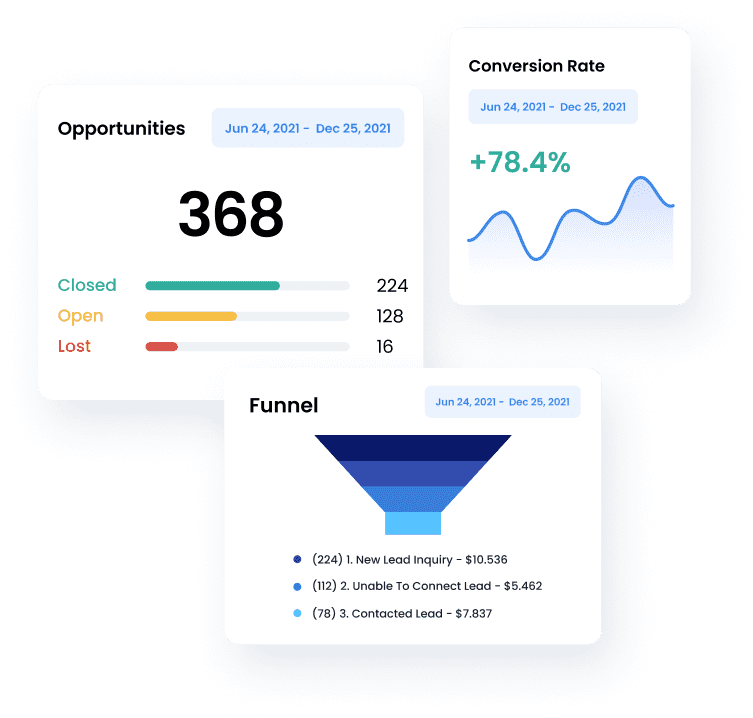
Most CRM platforms, including SMBcrm, track these metrics automatically when your forms, landing pages, and pipelines are connected. Your CRM analytics dashboard should give you a real-time view of what is working and what needs attention.
If you are using separate tools for your website, ads, and CRM, make sure they are integrated so data flows through cleanly. Disconnected tools create blind spots — you might think a campaign is underperforming when the issue is actually a tracking gap.
Frequently Asked Questions
What is a good conversion rate for a small business website?
Most small business websites convert at 2% to 5%. A “good” rate depends on your industry, traffic source, and what you are measuring — but if you are consistently above 3%, you are performing better than the majority of small businesses. Top performers hit 8% or higher by combining strong landing pages with fast follow-up and CRM automation.
How do I calculate my conversion rate?
Divide the number of conversions (form submissions, purchases, signups) by the total number of visitors, then multiply by 100. For example, 50 conversions from 2,000 visitors = 2.5% conversion rate.
Is a 1% conversion rate bad?
It depends on context. For e-commerce with high traffic volume, 1% can be profitable. For a service business relying on a small number of high-value leads, 1% is likely too low — it means your traffic, messaging, or landing page experience needs improvement.
What is the fastest way to improve my conversion rate?
Start with your highest-traffic, lowest-converting pages. The most common quick wins are simplifying forms (fewer fields), improving CTA copy (specific and benefit-driven), and adding social proof near the conversion point. Implementing automated follow-up workflows also dramatically improves the lead-to-customer conversion rate downstream.
How often should I test my conversion rate?
Continuously. Run A/B tests on major pages at all times, and review your conversion metrics weekly. Small improvements compound — a 0.5% lift each quarter adds up to significant growth over a year.
The Bottom Line
A “good” conversion rate is one that is improving. Benchmarks give you a starting point, but the real value comes from understanding why visitors convert or do not — and systematically removing the friction that stands in their way.
Start with the basics: match your landing pages to your traffic, simplify your forms, write specific CTAs, add social proof, and automate your follow-up. Those five changes alone can double most small business conversion rates.
Ready to Convert More Visitors into Customers?
SMBcrm gives you the landing pages, forms, pipeline management, and workflow automation you need to capture and convert leads — all in one platform.